A different approach to my game design
After a 3 year hiatus in game design, I finally returned with a new project: Honeypot — and it’s very different from my previous game, Fantastic Factories! Fantastic Factories was a puzzly multiplayer solitaire style experience. While I love exploring game systems and min/maxing my turns I discovered that it was actually quite difficult to introduce Fantastic Factories to my friends and family and to get it to the table. Additionally, most of my gaming these days (aside from playtesting prototypes) happens at conventions, and when I’m at the table I want to be seeing, interacting, and bantering with players. I still feel Fantastic Factories is a great game, but its heads-down experience just wasn’t a joy I could easily share and create moments with.
So in contrast, I set a few design goals for my next design (which eventually led to Honeypot):
It should be highly interactive between players.
It should have some element of mind games to make the game replayable and a new experience with each different group of players.
It should be easy enough to introduce and play with people who are not hobby gamers.
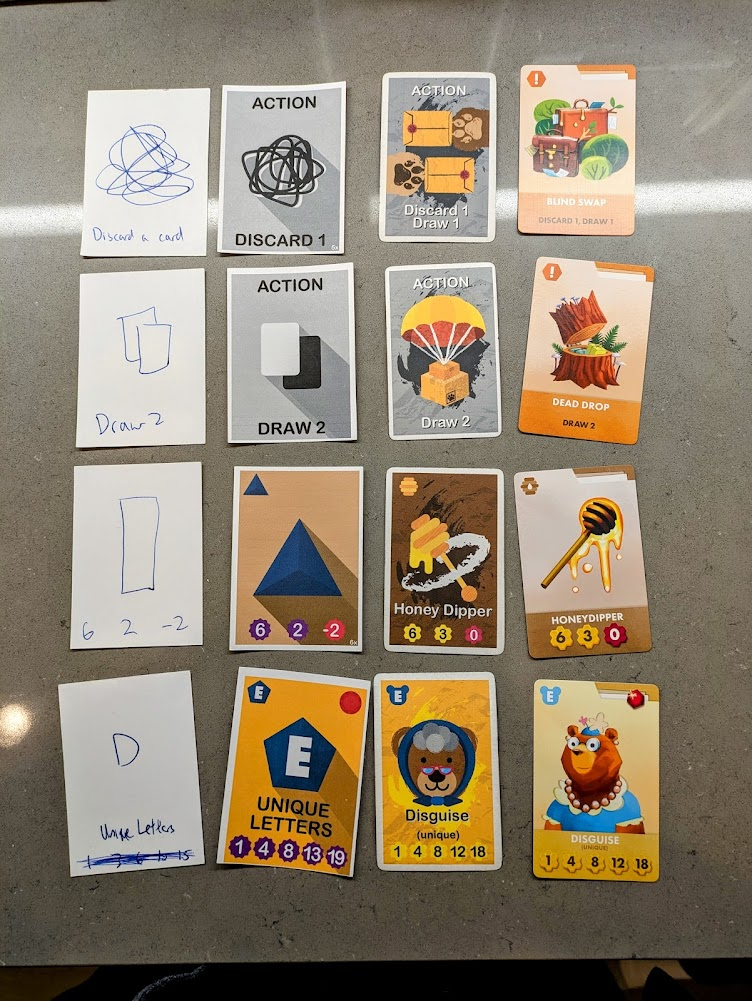
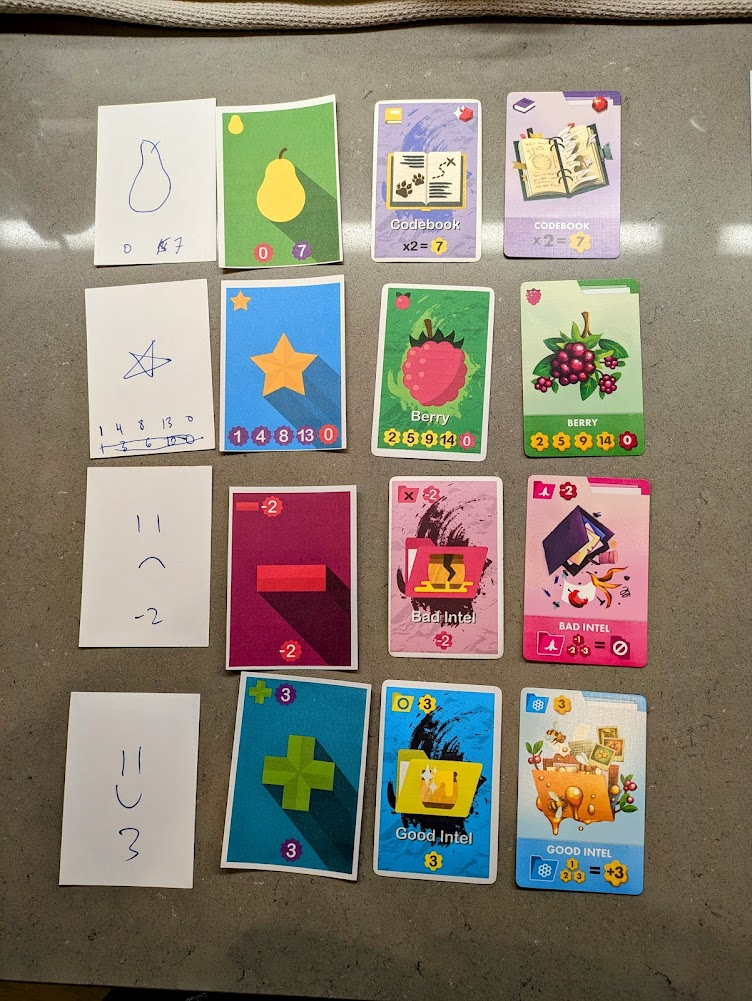
Evolution of what the cards looked like (early prototype on the left and final cards on the right)
I stack you choose
Immediately I had a game mechanic in mind. A few years ago I played a game that used the “I stack you choose” mechanic, which is a brilliant push your luck drafting mechanic where the draft piles were architected by the players themselves.
In each round, you are dealt three cards; you look at them, decide on the order in which to stack them, then pass that stack to another player. You’ll receive a stack in turn, which is in effect a “press your luck” deck created by an opponent. You look at the top card, then decide whether to keep it or discard it and draw the next card, which you can also discard in favor of the third card.
I thought this was a really fun way to gain cards. Are your opponents going to put the best card first or at the bottom? Or is the final card something you don’t want at all? There was a lot of opportunity for mind games and trickery.
However this mechanic was only a minor piece of that overall game. I wanted to design a game that promoted this mechanic from a supporting role to becoming the star of the show.
Every designer has a different approach to game design. For me, I hyperfocus on where I think the fun is, and I obsessively strip out anything that isn’t in service of that fun. I value simplicity and elegance above almost everything else.
At first I designed the game as a set collection game that used the exact same “I stack you choose” mechanic with just 3 cards. I asked: “What motivates you to pick one card over another?” The simplest answer is that some cards are worth more points than others. Set collection is one of the oldest mechanics in board games and is generally well understood, so I decided to go with that to validate the idea in the fastest way possible.
For my first playtest, I didn’t make ANY components at all. Instead, I used the cards from Sundae Split (designed by Nate Bivins) and simply dealt out 3 cards to each player to stack in a particular order. Of course there were some very rough edges, but it ended up being promising and the idea had legs. This led to me building the first prototype with the working title of “Stacked”.
Maximize the drama
As with any good design, a game needs to have relevant, engaging, and interesting decisions. Additionally, I knew that with a mechanic like this, there was the opportunity to create some memorable moments when players pick either the correct or wrong cards to keep. So I came up with a few guiding principles for the card designs:
Ideally all cards should be relevant to players at any point in the game. Depending on the circumstances, each card should at least have a chance to be highly desirable or undesirable.
The value of each card should vary depending on what cards players already have in the tableau – and that information should be open to all other players.
In order to create memorable moments, the cards should MAXIMIZE THE DRAMA — meaning the game should support big highs and lows as players reveal potentially very impactful cards.
With this in mind, I created a few types of cards:
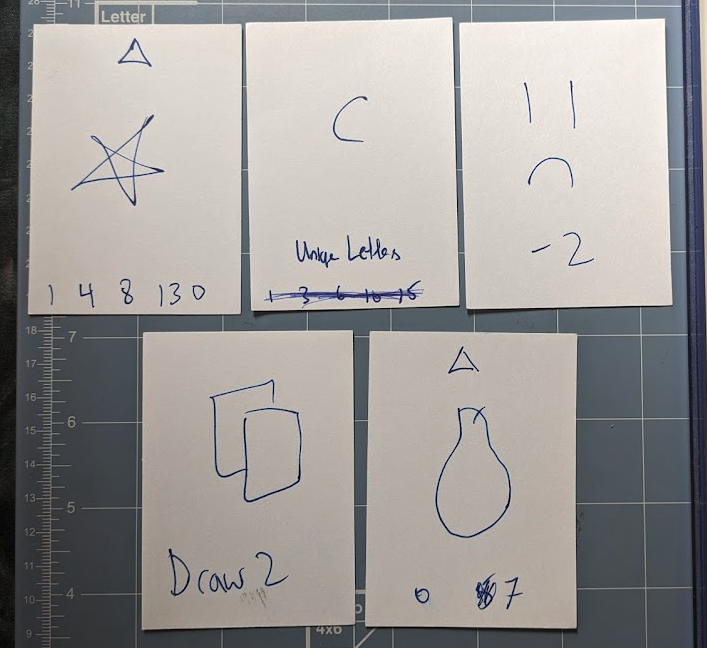
Stars — The more star cards you add to your tableau the more they increase in value until you get too many and they become worthless.
Letters — You want to collect unique letters. A particular letter may be more valuable to a player depending on what letters they have already collected. This rewards players for paying attention to what others have in their tableaus and planning accordingly.
Negative points — Many set collection games don’t have negative points because nobody would willingly pick them. But for a game where you can compel someone to commit to keeping cards without seeing them first, negative cards supported the design goal of maximizing the drama.
Draw 2 — The majority of cards in the deck are positive so Draw 2 is often powerful. However there’s always a chance you might draw that final star or a negative card.
Pears — If you only have a single pear it’s not worth anything. If you have two of them (get it? pairs?) they are worth a significant amount of points. This makes a single pear pretty underwhelming but getting a second one very good.
There were other cards in this early prototype as well, but these were a few of the interesting ones.
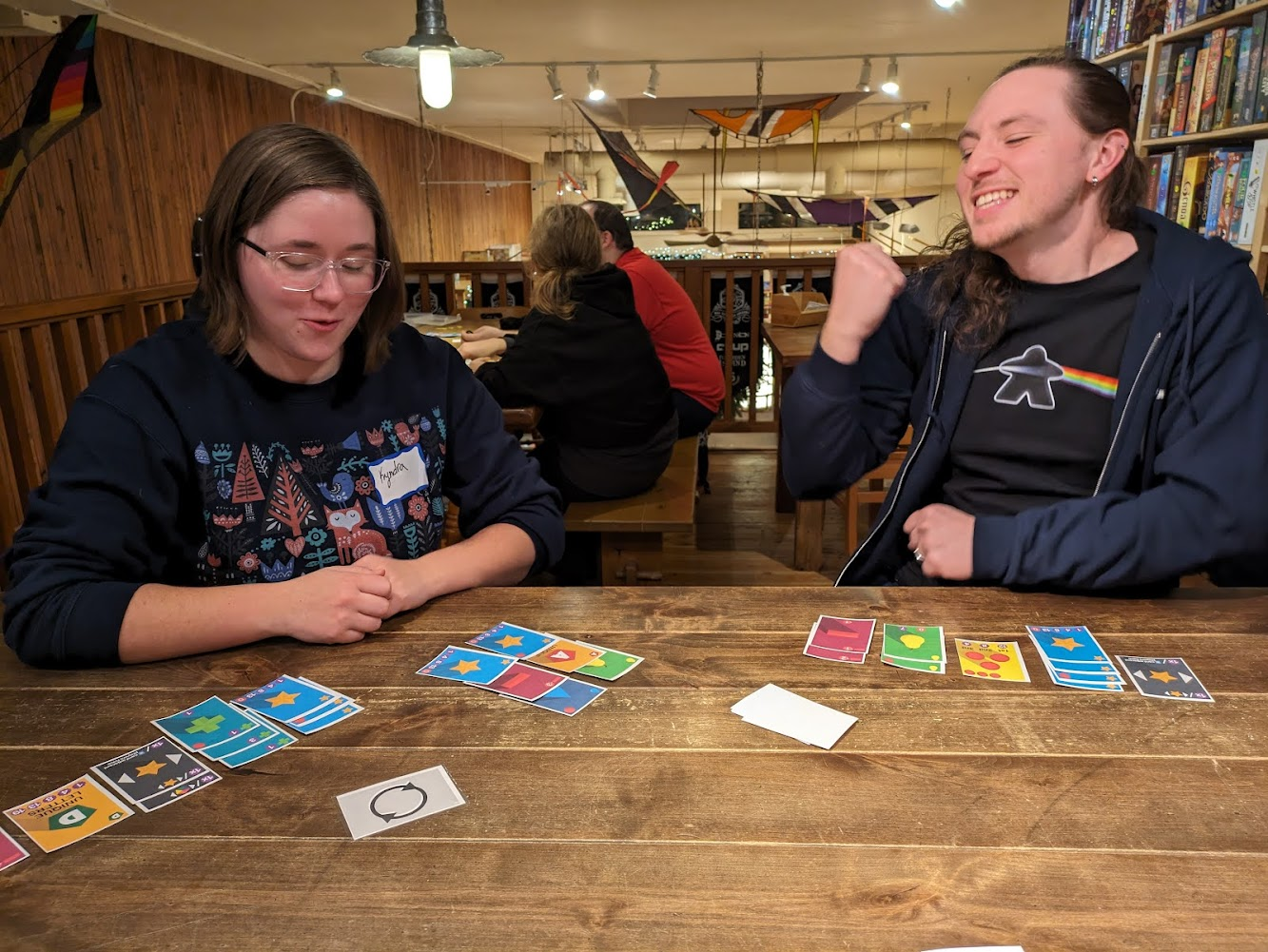
Josh reacts to Kyndra getting stuck with a 5th star.
There is always a chance….
Now in a game with this much volatility and swing in scoring, it’s possible players may feel “out of the game” if they’ve had a couple bad turns and collected negative cards. It’s tricky because maximum drama and volatility go hand in hand, and this is the heart and soul of the game. However, I certainly wanted to avoid having a player feel like they’ve lost the chance to win, especially early in the game.
To mitigate this possibility and in adhering to the guiding principles of the design for this game I introduced the Discard 1 card (which later became Discard 1, Draw 1):
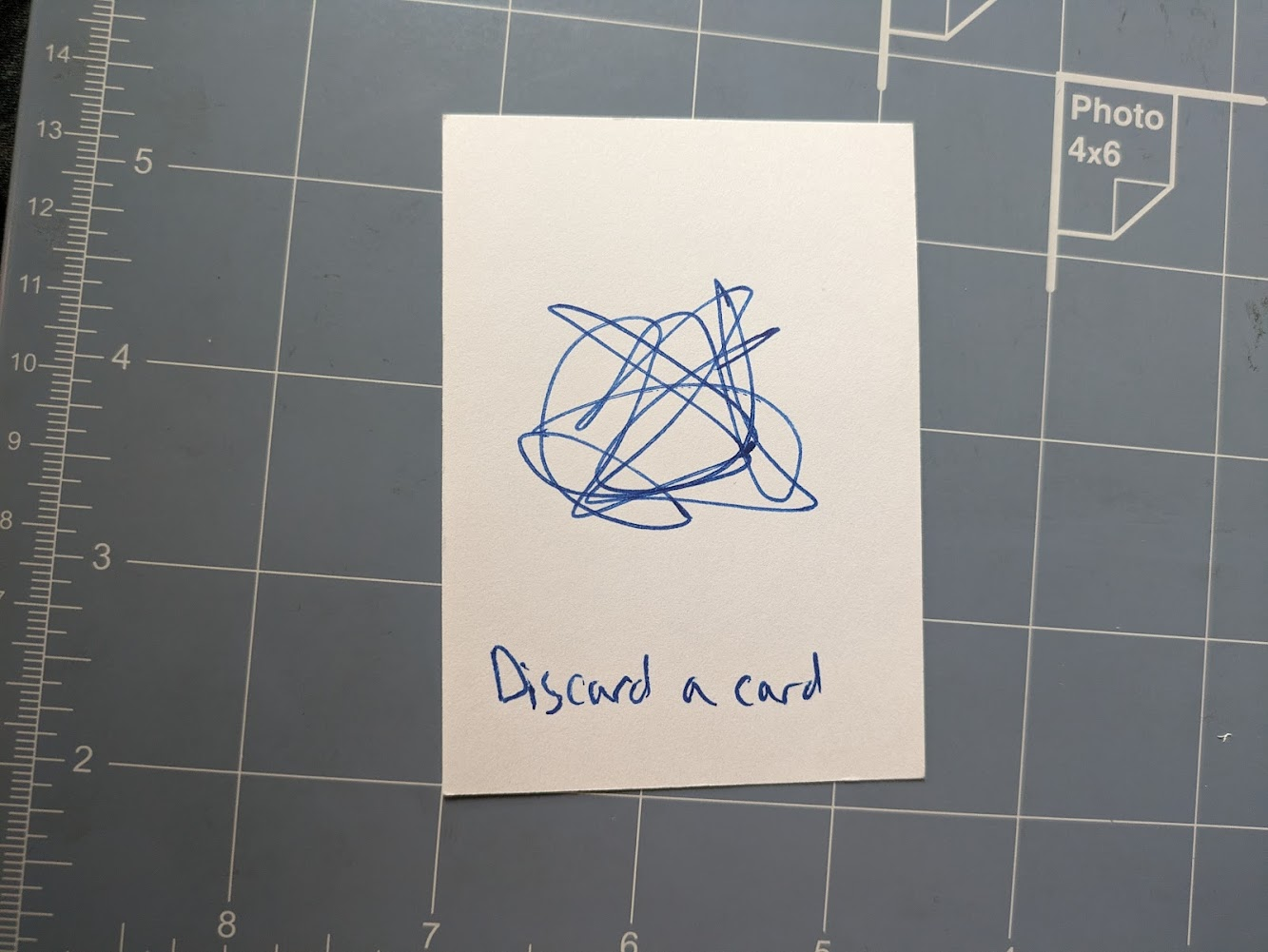
This card ended up having a very important function. For players who are ahead and don’t have any negative cards in their tableau, this is a bad card. For players who have negative cards (or perhaps that final star), they have a chance to get back into the game.
“Stacked” (now Honeypot) isn’t necessarily a game that needs a catch-up mechanic, but players need to feel like they can win throughout the game. And that’s largely a psychological thing. If players know they have a chance to get rid of a card that is completely sinking their score, they are more likely to stay engaged.
In addition to the new Discard card, the game design had a few things going for it to mitigate what effectively could feel like player elimination. Ultimately the game is short (20-30 minutes) and so this problem is lessened by knowing you can shuffle up and play again in just a short while. Also there are still opportunities for players to make clever plays and create dramatic moments where players fall into or avoid traps. Plus it’s fun to see others fall into traps even if it wasn’t one of your own making.
All in all, it’s been such a different experience designing a game like this compared to a eurogame, like Fantastic Factories, that is typically low conflict. It’s important to understand what your game is or isn’t. Rather than making sure each card was balanced, the drama is where the fun is, and I believe that you need to lean into the fun. It took some time to wrap my head around it, but that’s why early on it’s incredibly valuable to establish guiding design principals to adhere to.
Overcoming some challenges
After some playtesting I identified a few key problems with the design that I needed to fix:
It was taking a long time for players to collect any meaningful number of cards. For a game where the scoring is based on set collection, only keeping 1 card per round made the pace of the game fairly slow.
Sometimes there were no interesting ways to stack the cards. With 3 cards there are only 6 different ways of sequencing the cards and if they’re all good cards, it didn’t feel like you were making any meaningful decisions.
I experimented with a variety of solutions and in the end one adjustment stood out far beyond the rest. Rather than stacking 3 cards and revealing/keeping 1 card at a time, the groundbreaking change was to stack 6 cards and reveal/keep 2 cards at a time. This dramatically increased the number of possibilities from 6 to 90 different arrangements of the cards! This provided players with so much more agency. They could pair up good cards with bad cards to try to make the choices mediocre. Or they could go all in and put the best (or worst) cards all at the end. It also meant that as you took cards from stacks passed to you, you would take cards you may not have planned for, creating more possibility of interactions between cards. For example, if you are collecting Disguise cards you might take a pair of cards containing a Disguise that might also have a Berry. Now you find yourself collecting Berries as well and that information can be used to influence the stacking order in the future.
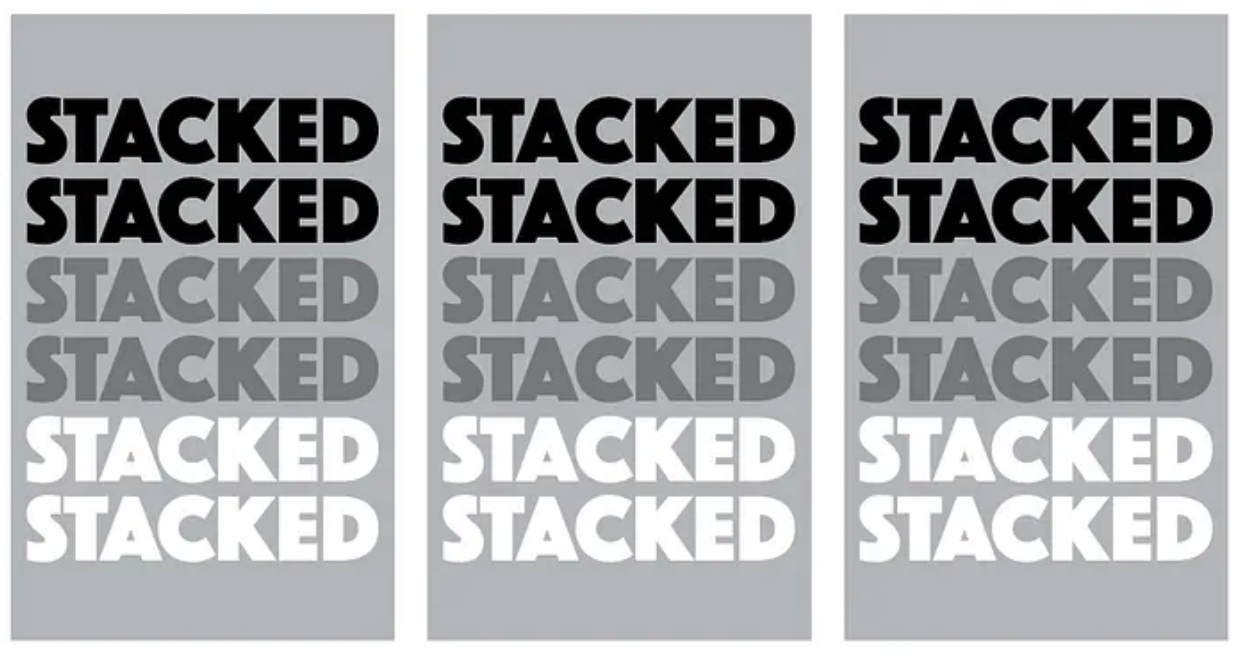
These are the backs of the cards for the prototype, which visually represent the stack of 6 cards grouped as 3 pairs of cards.
Suddenly the decisions within the game were so much more interesting and the pace of the game moved much quicker. Additionally, the overhead of stacking and revealing cards became much easier to justify when there was twice as much happening each round.
Once I had established the core principals and philosophies behind the game and then discovered the right mechanism to deliver on those promises, the rest was history. Balancing, iterating, and refining until it became what it is today – Honeypot, an “I stack you choose” game where you play as secret agent bears trying to set traps and avoid traps!
The Kickstarter Edition of Honeypot is now available on Gamefound!