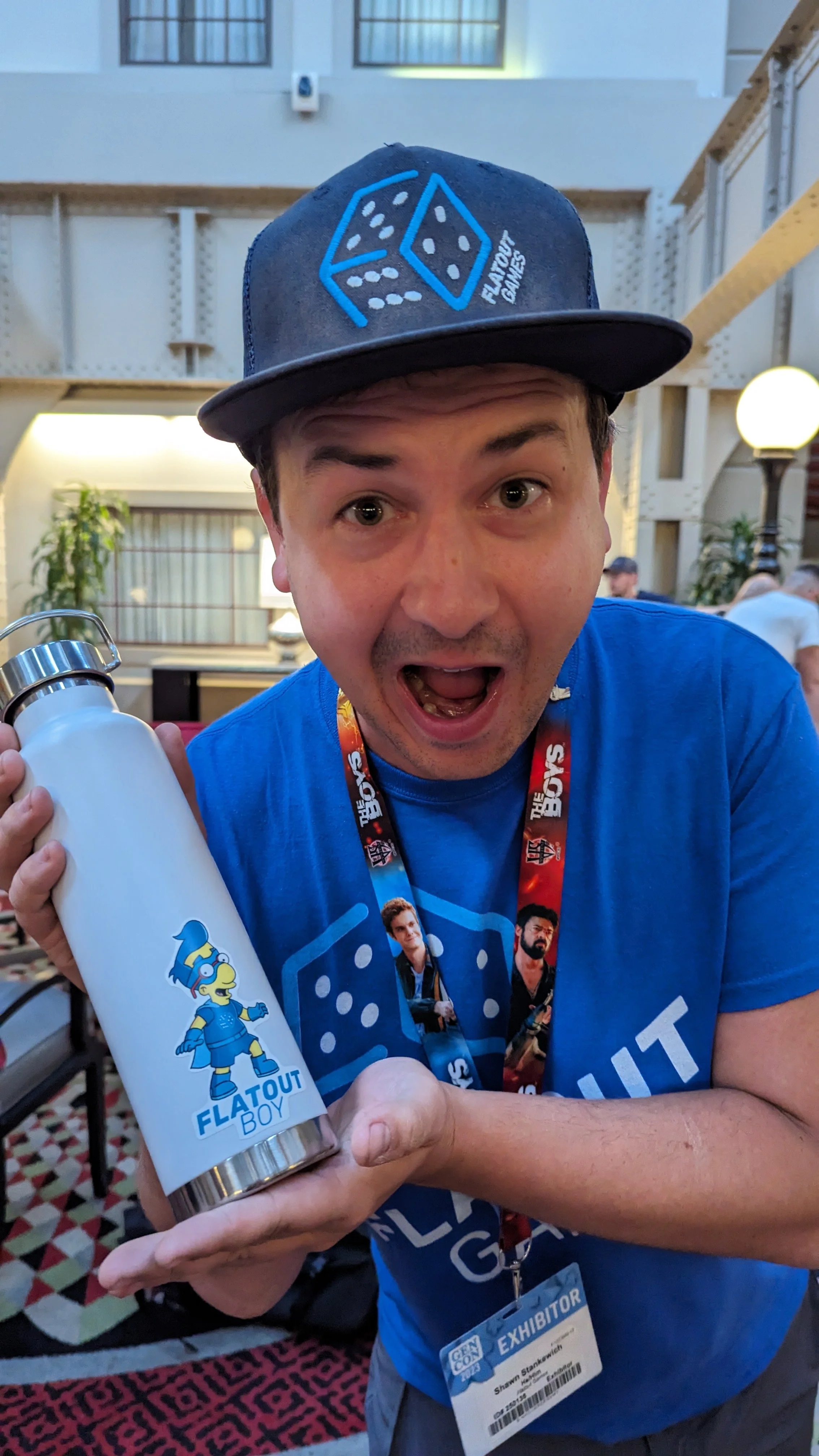
Our team recently got hockey sweaters to wear at conventions and the person wearing the C (for captain) is Shawn. He is our fearless leader and the glue that holds Flatout Games together and pushes the whole endeavour forward. He is both a prolific designer and the lead developer on all Flatout Games projects.
What are some of your favorite tabletop games? And why?
I have always been really interested in the inner workings of games - the rules and mechanisms that make great games ‘work’. All of the elements should contribute to the overall experience of the game.
I play board games for a number of reasons. First, I really love the social aspect of playing games with friends or strangers - it is a shared experience that allows for different types of interactions and emergent conversations; a chance to have a shared experience that can take you on adventures or open your mind to new ways of thinking… or just make you laugh hysterically.
Secondly, I love playing games for the ‘puzzle’ within them. How do you optimize something based on the resources or inputs given? How do you find the best solution when there are so many possible choices and outcomes? This is an aspect of games that I really enjoy engaging with. So, for all of these reasons, I think my taste in games is pretty broad. I am, of course, very biased towards all of the games in the Flatout Games catalogue. I really like that we’ve developed these titles in such a way as to be as approachable as possible, while also being strategically deep with multiple paths to victory and a lot of interesting decision space to explore each time you play.
Some of my favorite non-Flatout Games include: Skull, 2 Rooms and a Boom, So Clover, Belratti, No Thanks!, Biblios, Reef, Azul: Stained Glass of Sintra, Patchwork, 7 Wonders, 7 Wonders Duel, My City, Sprawlopolis, and Bomb Busters.
What got you into game design?
I think I have always been a ‘maker’. Anytime I get into a hobby, I always want to find a way to create things within that hobby. In 2010 I started playing modern board games and it wasn’t long before I was wondering what it might be like to create one. When I moved to Seattle in 2014, I discovered Blue Highway Games and hung out there for various board game events and meet-ups. I loved the community around games and met a lot of amazing people. It was not long after that I started designing games.
Stumbling upon the YouTube channel 1000XP by fellow Seattlite designers Chris Rowlands and Matty Christiansen and I was immediately inspired by their message to get your ideas to the table! I remember staying up super late in my tiny apartment working on a simple dice and cards game that included engine-building and recipe fulfillment. It was all done with blank cards with scribbled notes and standard D6s. I worked on that prototype for weeks. It didn’t end up being a design worth pursuing, but by then I had convinced my friends (Molly, Robb, and Justin) to start a board game design collaborative, to design games together, and that’s when Dollars to Donuts and Abstract Academy were born. The rest, in a way, is history. I spent the next couple of years attending every board game convention I could, engaging with fellow designers on Twitter, and getting as involved in game design as I possibly could!
What do you enjoy most about game design?
It is definitely the initial ideation process. I love sitting on the bus or train with a notebook and just starting off on the process of trying to design a game. Sometimes it starts with a theme that I want to explore, or a mechanic that I find interesting. Usually it’s about finding streamlined and simple mechanical ideas and then combining them in novel and interesting ways. I really appreciate the thought that ‘what people are looking for in a game is something familiar and something that is new to them, combined’. I can’t remember where I heard this exactly, but it resonates with me and I think it’s true of most of the most popular board games. You don’t need to invent something entirely unique, you just need to craft something that is carefully constructed to provide players with an experience that has some familiarity, while also giving them something new and remarkable.
I really like those initial design ideas and all of the iterating that happens before a prototype even gets constructed. What I find fascinating is that the more you do this, the more you can figure out before you even get it to the table and in some of our most recent designs, we have put something on the table for the first time that was not only stable and ‘worked’ but was fundamentally fun and interesting and had a solid core right from the beginning. I still love playtesting and iteration through play, but it’s pretty amazing when something comes to the table and just clicks!
The other aspect that I love is working with others. All of my designs have been co-designs because I really like working as part of a team. I take a lead design role on many of the designs that I am a part of, but working together towards shared goals is more fun and results in a much stronger design because you just have so much more opportunity to internally check one anothers’ assumptions.
Do you start with theme or mechanics?
I would say that 90% of the time, I start with mechanics. I do think it is important to iterate back and forth between the two a lot so that they are very well integrated. Most of the experiences I am most excited for players to have are based on the way mechanics come together, so a lot of designs start there.
Do you have a favorite theme?
I mostly like themes that are non-violent and are real-world based (though, I also enjoy fantasy and sci-fi quite a bit!). I like nature and science themes especially since you can often learn something about the natural world that you didn’t know before playing.
Do you have a favorite mechanic?
Hmm. No, I wouldn’t say so. I think I generally prefer games that are ‘puzzly’ and require both strategic and tactical thinking. I don’t like targeted player interaction or ‘take that’ mechanics very much. I love games that let you ‘build something’ throughout the course of the game. That might be a tableau of cards, a map, a spatial puzzle of some sort, etc. I generally gravitate towards mechanics that are spatial and require spatial reasoning to engage with. That said, I also love highly interactive mechanics like auctions/bidding, etc. where players’ actions impact the other players, but not necessarily in a negative way. I don’t love ‘feel bad’ moments, but I do love tension.
You have said about running a board game publishing collaborative that it is like you are playing ‘the world’s heaviest Euro Game’. Tell me why you draw those comparisons.
Ha! Yes, I have said that a few times. It’s true! The number of different skillsets you need to have and tasks you need to do is VERY broad when it comes to making board games. I love it! It’s like playing a game with a lot of very intricate, nested mechanisms that you need to consider at the same time. Making great games isn’t just about a novel idea; 99% of it is about the hard work it takes to get it out there to the world.
At Flatout Games we have a collaborative spirit and that teamwork that we embody every day has meant that a small team with no one working fulltime has been able to make several games per year. I am really proud of our team for this fact. We have built systems and efficiencies that allow us to do more and spend less time on the things that are repetitive and boring and more time doing the things that go into making better and better games. From the initial design to game and product development to manufacturing there are so many things that go into making a product. But the catch is, it doesn’t stop there. How do you get this product in front of people, sell it, support it, and build a community around it. It’s all part of being a board game publisher and something that I think feels a bit like playing a crunchy, heavy, Euro Game!
What skills do you think you came into this industry with and what have you learned?
My background is in design. Even from a young age I always wanted to build stuff. I have an undergraduate degree in Environmental Design which is a pre-architecture generalist design degree. I learned a lot through my studies - lots of graphic design and desktop publishing skills, along with spatial and product design skills. On top of that, whenever we designed something there was a large presentation component, which in a lot of ways was about selling your ideas and the products of your work. I think there is a lot of this formal education that helped give me a really solid foundation in game design and publishing.
I also have a Master of Landscape Architecture degree and am a licensed landscape architect. I have been working in landscape architecture for almost 15 years and I have picked up a lot of project management and team workflow and process skills along the way. I think these skills have also helped me in board game publishing as I find myself leading teams and managing a LOT of projects at once (at last count, I think I was just entering my time into 15 different project timesheets for time tracking last week - so much going on at Flatout Games!)
I have learned a lot from my peers in the board game industry. We have had countless conversations about what makes a great game, how to sell games, how to make games better, how to build communities, how to support others, how to constantly improve upon your craft. I owe so much to the people I have worked with directly and indirectly. It is a great community and we have built a super fun collaborative team at Flatout Games and every year more and more folks join the fray. I learn something everyday from someone and that’s what makes this work so rewarding!
What is something unusual/cool about you that people might not know?
Hmm - let’s see. When I was in high school, I competed in the Envirothon which is an international environmental competition. My team won our provincial championship and I got to compete at the finals. We didn’t win, but after high school I coached my school’s team for a number of years and in 2011 we won the championship - it was a super cool experience! A team of 5 students from a town in the middle of nowhere in northern Canada beat out thousands of other teams for the top spot! Through the years participating I learned a lot about ecology, environmental issues, public speaking, and creative problem solving. Competing as a student and as a coach was so fun!